What is the fastest way to improve at blending?
Paint the boundary before the interior. Most failed blends are outline problems, not color problems.
Core skill
Blending is shape first and color second. Here is the order that makes a character read as part of the painting.
Updated
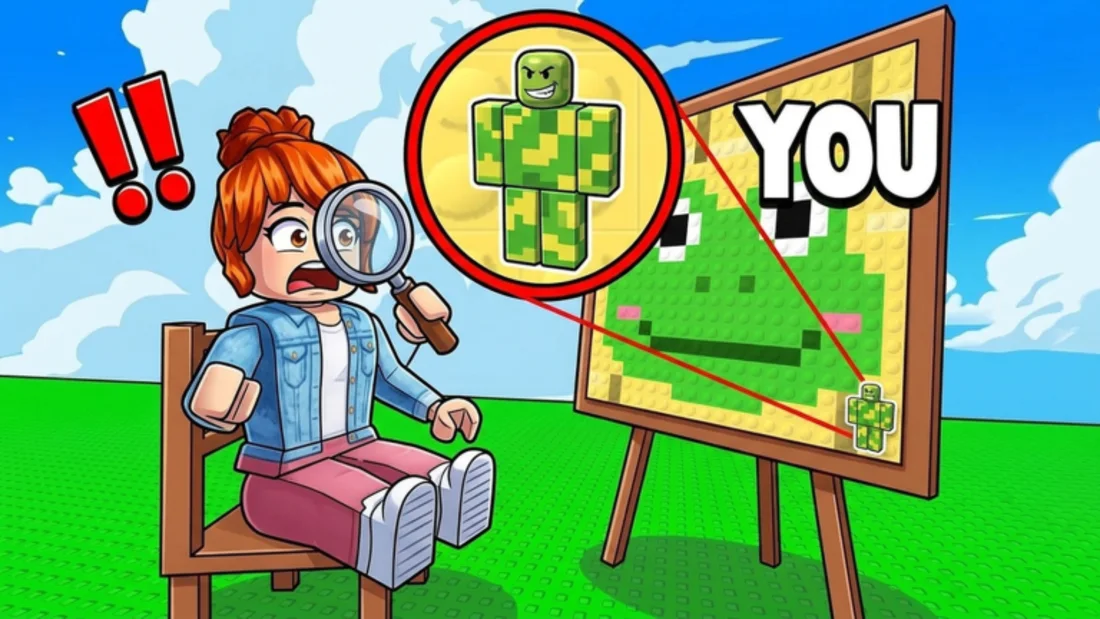
Most players think blending is about finding the exact color. It is not. The seeker's eye is pulled toward edges: the line where your head meets the background, the gap between your arm and your torso, the straight side of a leg that the painting does not have. If those edges disappear, a slightly wrong shade is easy to miss. If those edges stay, a perfect shade will not save you.
That is why two players can use the same colors and get different results. One copies the color onto a rectangular body and leaves a clean outline. The other uses the same color to break the outline into the shapes around it. The second player is not more accurate. They are less recognizable as a character.
The practical rule: paint the blocks that touch the background first, then fill the interior. Beginners do the opposite. They paint the chest and the face, run out of time, and leave the edges in the default color. The seeker sees a clean outline around a painted center, which is the easiest shape in the game to spot.
Pick three colors from the palette: a dominant background color, a darker shade for the painting's shadow shapes, and a lighter shade for highlights. Three colors cover most hiding spots. More colors add detail but also add chances to introduce a shade that does not appear in the painting.
The dominant color goes on the largest part of your body. The darker shade goes where the painting has a dark mass, usually around the head, shoulders, or feet. The lighter shade is for the blocks that catch the eye, such as the top of the head or the edge of a limb. If the painting has no dark mass near your spot, do not force one. Use the second color for the next most common shade instead.
Once the three-color base is down, stop and look at the result from the seeker's distance. You are not checking whether the colors are pretty. You are checking whether your body still reads as a separate object. If it does, the base is not finished.
| Color role | Where it goes | Why it matters |
|---|---|---|
| Dominant | Torso, legs, the largest visible area | Matches the field the seeker sees first |
| Dark | Head, shoulders, feet, any block that crosses an edge | Breaks the silhouette the seeker is scanning for |
| Light | Small highlights near the top or side | Prevents the character from reading as a flat cutout |
Your outline is the boundary between your character and the painting. It includes the sides of your torso, the shape of your head, the gap between your arms and body, and the line where your legs end. Every one of those boundaries is a clue. The goal of blending is to replace the outline with shapes the painting already contains.
Start with the head. It is the most recognizable part of a Roblox character and the first thing a seeker checks. If the painting has a dark patch near your hiding spot, put that dark color across the top and sides of your head so the round shape stops reading as a head. If the painting has a light background, do the opposite and remove the dark cap.
Then fix the shoulders and hips. Those are the widest points of the character and the easiest place to see a straight line. Use the background color to extend the painting's shapes across your shoulders. Finally, check the feet. A pair of clean, symmetrical feet is a giveaway even when the rest of the body blends.
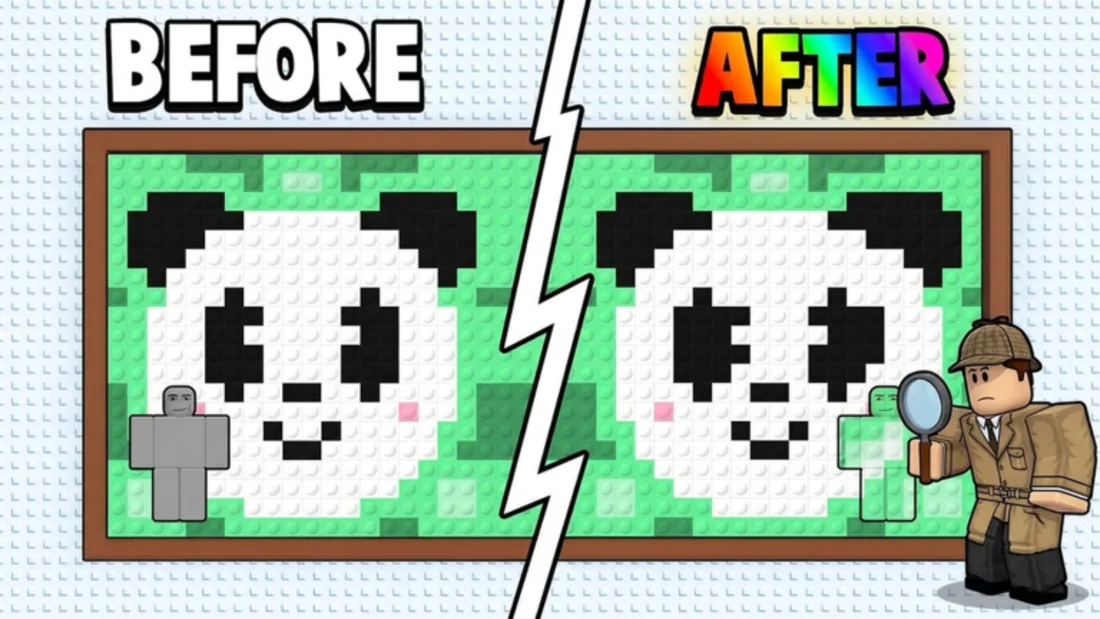
The painting's main subject is a trap. It is the most colorful, most detailed part of the image, and it is usually where the seeker looks first. If you paint yourself like the subject and stand next to it, you create a second copy of the thing the seeker is already studying.
Instead, choose a spot where the background has a pattern you can continue. A patch of sky with a few clouds, a wall with repeated blocks, or the side of a large shape all work better than the subject's face. The seeker's attention is on the subject; your job is to be part of the scenery around it.
This is also why the edge of a color region is a strong spot. At the boundary, the painting already has a transition, and your body can join that transition. In the middle of a flat color, you have to create the transition yourself, which takes more blocks and more time.
Busy paintings are more forgiving than clean ones. A painting with lots of small color changes gives you places to hide a block that is slightly off. A painting with a flat sky or a single-color wall gives you nowhere to put a mistake. When you get a busy painting, pick a spot with the most variation and paint fewer, larger blocks.
Noise also helps with the freeze. A character standing in a quiet area is the only thing moving in that area, so any small adjustment is visible. A character standing in a busy area is surrounded by visual information, and the seeker has to work harder to separate the character from the pattern.
Do not confuse noise with detail. You do not need to copy every small block. You need to place your body where the existing noise covers the parts you cannot paint. The painting does the work; you just have to stand in the right part of it.
When a blend fails, the instinct is to start over. Usually, one or two blocks caused the problem. Look for the hardest edge on your character: the side of the head, the shoulder line, or the gap under the arms. Repaint that edge with the background color and leave the rest alone.
If the seeker has already seen you, changing everything is worse than changing one thing. A large repaint creates a visible change in the painting, which confirms that something is there. A small correction at the edge is less noticeable and preserves the work you already did.
The same rule applies to color. If one shade is wrong, replace the blocks that touch the background first. The interior shade matters less because the seeker's eye stops at the edge. Fix the boundary, not the center.
Open a private server and give yourself five rounds with one constraint each. Round one: only three colors. Round two: paint the outline before the interior. Round three: choose the spot before the first block. Round four: no repainting after the freeze. Round five: use the busiest part of the painting.
The constraint is the point. Most players practice by playing full matches, which mixes too many skills at once. A single constraint per round makes the habit stick faster, and the private server removes the pressure of a seeker who is actively hunting you.
After five rounds, go back to a public match and use the one habit that felt most unnatural. That is usually the one that fixes the most losses.
FAQ
Paint the boundary before the interior. Most failed blends are outline problems, not color problems.
Start with three. A limited palette is faster and leaves fewer chances to introduce a shade that does not belong.
Busy paintings only help if your body sits inside the busy area. A detailed painting behind a clean character outline still exposes the outline.